
Dickerson & Nieman Blog
 RSS Feed
Subscribe and receive email notifications of new blog posts.
RSS Feed
- 2026 | 19 Posts
- 2025 | 24 Posts
- 2024 | 24 Posts
- 2023 | 24 Posts
- 2022 | 24 Posts
- 2021 | 9 Posts
- 2020 | 26 Posts
- 2019 | 30 Posts
- 2018 | 43 Posts
- 2017 | 55 Posts
- 2016 | 64 Posts
- 2015 | 100 Posts
- 2014 | 108 Posts
- 2013 | 97 Posts
About Our Agents | 81 Posts
Articles | 2 Posts
Belvidere | 1 Posts
Buy a House | 10 Posts
Community Events | 30 Posts
Dickerson Nieman | 40 Posts
Dickerson Nieman Education | 2 Posts
Home Buying Tips | 4 Posts
Home Improvement | 15 Posts
Homeownership | 23 Posts
Hot Sheet | 9 Posts
Mortgage | 1 Posts
Moving Tips | 2 Posts
Mt. Morris | 1 Posts
OCI'S Blog | 4 Posts
ONLINE MAGAZINE | 27 Posts
Open Houses | 4 Posts
Oregon Real Estate | 1 Posts
Poplar Grove | 1 Posts
Real Estate Buying Tips | 7 Posts
Real Estate Career | 1 Posts
Real Estate News | 2 Posts
Rock River Valley | 4 Posts
Rock River Valley Schools | 1 Posts
Rockford | 32 Posts
Rockford Community Events | 21 Posts
Rockford Community News | 8 Posts
Rockford Jobs | 1 Posts
Rockford Public Schools | 4 Posts
Rockford Real Estate | 28 Posts
Rockford Realtors | 42 Posts
Rockford Youth | 4 Posts
Rockford, IL | 35 Posts
Rockton | 9 Posts
Roscoe Office | 9 Posts
Roscoe Real Estate | 6 Posts
Sell a Home | 7 Posts
Sunday Open Houses | 11 Posts
Top Producers | 8 Posts
Uncategorized | 142 Posts
Welcome New Agents | 7 Posts
Young Professionals Network | 1 Posts
February
27
27
Make Your Home More Cohesive in 2023
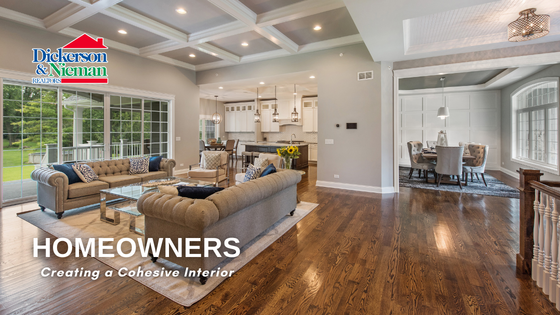
When it's time to decorate or update your style, there are ways to create a more appealing, cohesive home. Our real estate agents agree with interior design experts who know that common elements must run from room to room if you want flowing, harmonious spaces. Whatever your architectural and interior design style, a beautiful, well-planned interior takes planning.
- Use the Same Flooring Throughout the House
The flooring in your home is one of the most important factors in creating a cohesive flow. Using the same flooring throughout the house creates a feeling of more space and enhances visual appeal from room to room. When selecting flooring, consider its visual appeal, hardness, durability, slip resistance, and ease of cleaning, especially if you have children and pets. Many homeowners choose wood because it comes in various colors and patterns, and it's pliable, durable, slip-resistant, and easy to keep clean. - Choose Furnishings that Define Your Home's Style
If you're a buyer looking at Rockford homes for sale, you're likely drawn to certain architectural features found in contemporary, traditional, modern, or mid-century homes. To create a cohesive flow, define what you like and stay consistent with your design choices. For example, if you buy a mid-century modern home, the interior should reflect simplicity with straight lines and modern details. If your dream home is an Old English two-story with high beamed ceilings, your furniture should reflect traditional elegance and charm. - Keep Wood Stains and Trim Colors Consistent
To create a cohesive look throughout the house, repetition is essential. When it comes to basic design elements like doors, overhead beams, trim around doors and windows, and door handles, keep them all the same finish or color. If your house has natural wood trim around doors and windows, don't paint some white. If door handles and cabinet hardware is chrome or stainless steel, don't switch to brass hardware in some rooms just to be different. - Think About Contrast
Contrast is just as important as repetition in creating a cohesive interior. Although basic elements like doors, door handles, and trim should stay the same, you don't want every bathroom to have the same vanity, tile, and fixtures. To design a stylish room, some separation is necessary to keep things interesting. To make each room more unique with its own personality, choose different colors and patterns and rely on your basic color palette for a cohesive flow. - Join Spaces with Colors and Textures
When you're home has an open floor plan, like a family room that adjoins the kitchen, it's best to keep the same colors and textures in both areas. If your home has a more traditional floor plan with rooms divided by walls, you can change colors and textures as long as you choose complementary hues. First, choose a neutral hue like white, cream, or gray that works in every room, then add three or four brighter hues. Remember, textures can be found in many forms, like rugs, wallpapers, upholstery, bed linens, sculpture, and art. - Change the Mood with Lighting
Every room needs a combination of three types of lighting fixtures for good light: overhead lighting (recessed, spots, chandeliers, and pendants); ambient lighting (floor and table lamps and wall sconces; and task lighting (desk lamps and under-counter lights). When you have all three in each room, it's easy to change the mood and use the room for a variety of different activities.
If you're considering buying or selling a home in Rockford, contact us for information on great neighborhoods, available properties, and prices that fit your lifestyle.